Customer-Facing Collateral
Design it, pitch it, sign it off — the same building
Stage 12 is the meta layer: it doesn't add a new connectivity path, it decides how hard to lock down all three at once and proves it. 12.1 pours the foundation (sizing you can't redo) and counts the doors (Managed → Hardened → Isolated). 12.2 is the guided tour of six trust pillars. 12.3 is the pre-flight checklist where every switch has a confirmation light (the verify step).
🧠 Mental model — hold this in your head
Design, pitch, and sign-off for one building. A fixed-size plot of land (the VNet — footings you can't widen), wrapped in a progression of gates you bolt on only when needed, explained through six pillars, and signed off with a 13-item inspection. Secure by default, hardened by configuration, sized once for peak — and we prove every control is on, not just configured.
The three artifacts mapped to the three paths
| Artifact | What it delivers | Touches |
|---|---|---|
| 12.1 Sizing & decision guide | CIDR/subnet worksheet + Managed/Hardened/Isolated tree | Shapes the VNet (paths ②③); chooses controls across all three |
| 12.2 Security overview | Six pillars: isolation, network, encryption, identity, compliance, audit | Overlays all three paths; default vs opt-in |
| 12.3 Hardening checklist | 13 items, each with why / how / verify | One control bolted onto each hop of ①②③ |
Static topology (zoom-crisp, reusable in slides)
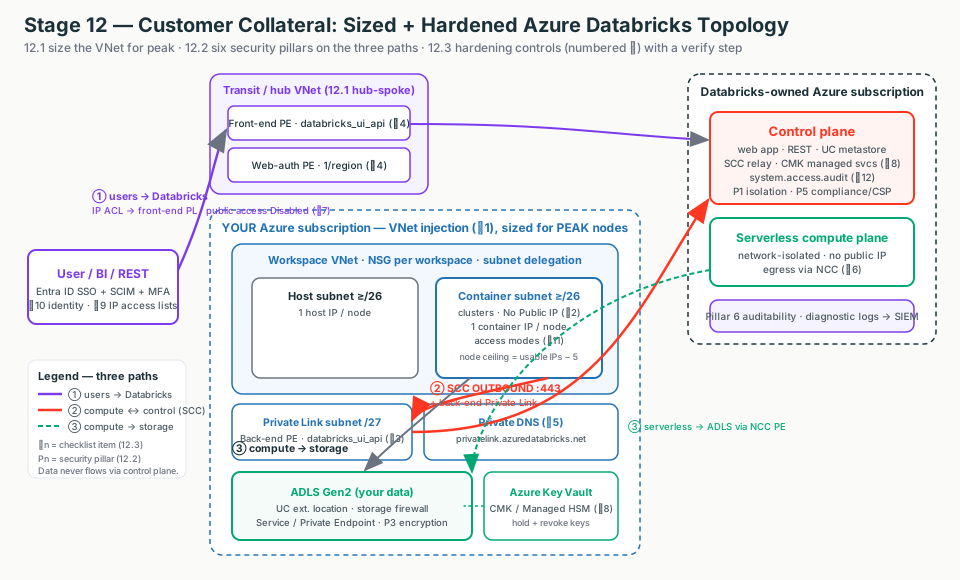
The line a security team wants to hear
"We size the network once for your peak so you never rebuild, we add exactly the locked doors your regulator requires, and we hand you a checklist where every control has a confirmation light — not a marketing claim, a verifiable control with a doc behind it."
Terms used here (full deep-dive lives in the owning module)
- VNet injection
- Classic compute in your VNet so you own subnets/NSGs/routes. → M2.1
- SCC / No Public IP
- Clusters dial outbound :443; no inbound ports. → M2.3
- Private Endpoint / Link
- Private NIC+IP mapping a service to a private address; needs DNS. → M2.5/M3.1
- Private DNS zone
privatelink.azuredatabricks.net— resolves the URL to the PE IP. → M3.2- NCC
- Account-level, regional object giving serverless stable egress + private endpoints. → M4a.2
- CMK
- Your keys in Key Vault / Managed HSM; revoke to cut access. → M4b.4
- CSP
- Compliance Security Profile — CIS-L1 image, ESM, auto-update, TLS 1.2+. → M4b.6
- IPAM
- The customer's IP Address Management team — source of a non-overlapping CIDR block.
12.1 · Sizing & architecture decision guide
Two deliverables: a CIDR/subnet worksheet (size once for peak — subnet CIDR is immutable) and a topology tree (Managed → Hardened → Isolated). Switch the diagram between the sized VNet and the three reference architectures; click any box for the "what + why."
The two unfixable mistakes
Subnet CIDR is immutable after the workspace deploys — size for peak (+~30%), equal
host/container, VNet 2+ bits larger, a /27 Private Link subnet reserved. And
over-building the topology (Isolated + firewall) when an IP access list was the ask burns
cost and weeks of DNS work. Match the architecture to the requirement.
Subnet size → node ceiling (usable = 2^(32−n) − 5)
| Subnet CIDR | Usable IPs | ≈ Max nodes (all clusters) | Good for |
|---|---|---|---|
/26 | 59 | ~59 | Small/dev |
/24 | 251 | ~251 | Typical prod |
/22 | 1,019 | ~1,019 | Large prod / many jobs |
/20 | 4,091 | ~4,091 | Exceptional — usually split workspaces |
The three reference architectures
| Dimension | Managed | Hardened | Isolated |
|---|---|---|---|
| Public endpoint | Open / NSG-limited | IP access lists | Disabled (front-end PL) |
| Compute → control | SCC (backbone) | + classic Private Link | classic Private Link |
| Exfiltration | minimal | egress control | + Azure Firewall (hub-spoke) |
| Cost / effort | $ | $$ | $$$ (NAT+PE+firewall+DNS) |
| Tier | PE optional | Premium | Premium |
SCC + VNet injection are in all three — the baseline, not an upgrade.
Illustrative config — sized, delegated subnets (immutable)
Terraform (azurerm) — the CIDRs that set the node ceiling. Full VNet/NSG/NAT module is in the M2/M3 hands-on artifacts.
resource "azurerm_virtual_network" "adb" {
  address_space = ["10.50.0.0/16"]          # /16: room for big subnets + a PL subnet
}
resource "azurerm_subnet" "container" {     # "private subnet" — MUST equal host size
  address_prefixes = ["10.50.1.0/24"]       # /24 = 251 usable -> ~251 node ceiling
  delegation { name = "databricks-del"
    service_delegation { name = "Microsoft.Databricks/workspaces" } }   # required
}
# 10.50.2.0/27 left free for the back-end Private Link endpoint subnet.
Portal: Virtual networks → + Create → set address space → + Add subnet ×2 (equal, non-overlapping) → Azure Databricks → Networking → Deploy to your VNet = Yes. ⚠️ CIDR can't change after Create.
2026 deadline to flag
After 2026-03-31, new Azure VNets default to no outbound internet — a new workspace needs an Azure NAT Gateway on both subnets (also a stable egress IP) or clusters can't reach the control plane.
12.2 · Customer security & networking overview
The "is it secure?" briefing — six pillars, each a named, verifiable control. Switch the diagram between the six pillars view (where each pillar attaches) and the default vs opt-in view; click a box for the "what + why."
The one sentence
"Secure by default, hardened by configuration." The baseline (isolation, SCC, TLS, Entra ID, Unity Catalog, audit) is on out of the box on Premium; Private Link, CMK, and CSP are opt-in controls you add only when a named requirement justifies the cost. Every claim must match the deployed config.
Default vs opt-in
| Control | Default (Premium) | Opt-in | Answers |
|---|---|---|---|
| Plane separation / SCC | ✅ | — | "Where does data run? Inbound exposure?" |
| Encryption at rest | ✅ platform-managed | CMK | "Can we hold the keys?" |
| Entra ID SSO / SCIM / UC | ✅ | Conditional Access · ABAC (Preview) | "One identity? Row/column control?" |
| Front/back-end Private Link · NCC | — | ✅ Premium | "Off the internet? Trust serverless egress?" |
| Compliance Security Profile | — | ✅ Add-on | "PCI/HIPAA-ready?" |
Audit (system.access.audit) | ✅ (Preview) | SIEM export | "Who did what?" |
Illustrative config — prove the audit trail live
SQL — the query an FDE runs in front of the security team. Nothing lands better than showing the log.
SELECT event_time, user_identity.email AS who, service_name, action_name,
       source_ip_address, response.status_code
FROM system.access.audit
WHERE event_date >= current_date() - INTERVAL 7 DAYS
  AND response.status_code >= 400          -- 4xx/5xx = denied or errored
ORDER BY event_time DESC LIMIT 100;
Be precise — three over-claims that lose trust
CMK scope: covers managed services / DBFS root / managed disks — not serverless ephemeral disks. Serverless ≠ classic for CSP standard/region coverage. And don't say "fully isolated" unless front+back-end Private Link and public access Disabled are deployed.
12.3 · Deployment & hardening checklist
The pre-flight checklist — 13 items, each with why · how · verify. The whole list is the three-path scaffold with one control bolted onto each hop. Switch the diagram between the three connectivity paths to see which checklist items lock each; click a box for the proof.
"Configured" ≠ "effective" — the discipline
Half of field incidents are a control that was configured but silently not effective (an NSG rule overwritten, a Private DNS zone not linked, an audit schema never enabled). Every item has a one-command/one-click verify — read the light, don't assume the gear is down.
The 13 items (why / verify)
| # | Item | Why | Verify |
|---|---|---|---|
| 1 | VNet injection + sizing | Own NSGs/UDRs/DNS; foundation for PL. CIDR immutable. | Subnet shows NSG + delegation; cluster IPs in container range. |
| 2 | SCC / No Public IP | No inbound attack surface. | NICs have no public IP; enableNoPublicIp = true. |
| 3 | Back-end Private Link | Removes last public hop for classic. | PE databricks_ui_api Approved; nslookup → private IP. |
| 4 | Front-end PL + web-auth | Private user path; SSO over private. 1 web-auth/region. | URL → transit PE IP; SSO completes. |
| 5 | Private DNS | PE useless if DNS returns public IP. | nslookup from VNet → private IP. |
| 6 | NCC (serverless) | VNet injection doesn't cover serverless. | NCC binding + PE rules Established; serverless query succeeds. |
| 7 | Public access = Disabled | Rejects all public connections. | Outside corp net: URL unreachable. |
| 8 | CMK | You hold/revoke keys. | Encryption blade shows Key Vault URI. |
| 9 | IP access lists | Restrict front-end to known IPs. | Off-list blocked; egress IP in ALLOW. |
| 10 | Entra ID SSO+SCIM+MFA | Central identity; auto-deprovision. | Test user syncs/de-syncs; MFA enforced. |
| 11 | Cluster policies + access modes | Forbid legacy No Isolation Shared. | Legacy mode rejected for non-admins. |
| 12 | Audit logging | Immutable who-did-what. (Preview.) | Query returns rows; schema enabled. |
| 13 | Terraform IaC | Reproducible, drift-detectable. | terraform plan = no diff. |
Illustrative config — the SCC + VNet-injection workspace
resource "azurerm_databricks_workspace" "this" {
  sku = "premium"                            # Premium -> PL, CMK, IP ACLs, CSP
  custom_parameters {
    no_public_ip       = true                # SCC / NPIP (item 2)
    virtual_network_id = azurerm_virtual_network.adb.id   # VNet injection (item 1)
  }
  public_network_access_enabled = false      # item 7 (with front+back-end PL in place)
}
IP ACLs: databricks workspace-conf set-status --json '{"enableIpAccessLists":"true"}'.
NCC: Account Console → Cloud resources → Network Connectivity Configurations.
Decision guide — what an architect recommends
Managed security
- Startup / internal analytics, no regulatory driver
- Baseline: VNet injection + SCC + UC + Entra ID + audit
- Public endpoints OK; classic PE optional
- Dev/sandbox: checklist items 1–2 + 10–13
Hardened connectivity
- Must restrict who connects / control serverless egress
- + IP access lists + serverless egress control
- + classic & serverless Private Link (Premium)
- Add CMK if "hold our own keys"
Isolated environment
- Regulated (FSI / healthcare / gov) or "no public internet" mandate
- Front+back-end PL + NCC + public access Disabled
- Hub-spoke + Azure Firewall; CSP for the regime
- Full checklist; Premium; accept NAT/PE/firewall cost
Don't…
- Size subnets for today (CIDR is immutable — size for peak)
- Sell Isolated when an IP access list was the requirement
- Say "fully isolated" without front+back-end PL + public access Disabled
- Claim "everything encrypted with your key" — CMK has defined scopes
- Treat "configured" as "effective" — run the verify step
Rule of thumb
Start at the baseline, step up only when a named requirement justifies the cost — and prove every control is on, not just configured. Size once for peak (the cheapest insurance against a rebuild), and tie every opt-in control (Private Link, CMK, CSP — all Premium) to a regulatory or data-residency requirement, never "nice to have."
Customer Q&A — what the security team actually asks
Common asks & the answer
| Customer asks… | Architect answers… |
|---|---|
| "How big should subnets be — can we change them later?" | Size for peak via the worksheet; no, subnet CIDR is immutable — a rebuild is the only redo. |
| "Which architecture do we need?" | Run the tree: regulated/exfiltration → Isolated; ingress/egress control → Hardened; else Managed. Don't over-build. |
| "Does any traffic touch the public internet?" | With SCC + front+back-end PL + public access Disabled + NCC for serverless — no public path. |
| "Can we hold and revoke our own keys?" | Yes — CMK from Key Vault across managed services, workspace storage, and disks (not serverless disks). |
| "Are you PCI/HIPAA-ready, and what do we do?" | Enable CSP + the right standard; it's shared responsibility — config + free-text fields are yours. |
| "Prove the audit trail." | Run a live system.access.audit query in front of them. |
| "How do we prove each control is on?" | The verify column — each is one command or Portal check. |
What breaks in the field — and the FIRST check
"Cluster failed to start — insufficient IPs"
Container subnet too small for peak autoscale.First check: container subnet free-IP count vs peak nodes, minus the 5 reserved.
Clusters won't launch after enabling IP ACLs
The compute stable-egress IP isn't in the ALLOW list.First check: egress IP in ALLOW (or back-end PL configured) — not quota.
Workspace URL unreachable / SSO fails after Private Link
DNS still returns the public IP, or web-auth missing.First check: nslookup the host + the single regional browser_authentication endpoint.
Serverless can't reach firewalled ADLS
A classic NSG/UDR was applied; serverless needs NCC.First check: NCC binding + private-endpoint rule, not classic networking.
"Audit table is empty"
The system schema was never turned on.First check: system.access schema is enabled at the account.
"The overview doesn't match what we deployed"
PL/CMK/CSP are opt-in, not automatic.First check: workspace tier + which add-ons are actually enabled.
Three questions before recommending an architecture
- Is there a named regulatory mandate for no public-IP hop / data exfiltration protection — or is backbone-private enough?
- Do they need to restrict who connects and control serverless egress, or just secure defaults?
- What's the five-year peak node count (sizing), and are they on Premium (Private Link / CMK / IP ACLs / CSP are Premium-only)?